Philosophy / Knowledge quiz

Valid vs sound argument: a quiz on deduction, induction and fallacies

A valid vs sound argument differs because validity depends only on logical structure while soundness also requires premises that are true in reality. Questions cover deductive and inductive reasoning, analogical arguments, and common fallacies including straw man and false dilemma. Give the ten questions a try and see how you score.

10 questionsAnswers and score at the end
Practice quiz

Test your knowledge.

Question 1 of 100 answered

Adding up your answers

Your score is next.

Question 1

What is philosophical inquiry?

Philosophical inquiry methodically investigates foundational questions regarding existence, reasoning, and ethics.

Source excerpt
Philosophical inquiry is the systematic study of general and fundamental questions about existence, reason, and values.

From the Knowverse course text.

Question 2

What are the two necessary building blocks of an argument?

An argument requires premises to supply supporting reasons and a conclusion as the final claim.

Source excerpt
An argument requires at least two parts: a premise and a conclusion.

From the Knowverse course text.

Question 3

What makes an argument logically valid?

Validity is purely structural: if the premises are true, the conclusion is logically forced to be true.

Source excerpt
An argument is valid if it is impossible for the premises to be true while the conclusion is false.

From the Knowverse course text.

Question 4

What two conditions define a sound argument?

An argument is sound only when its logical structure is valid and all supporting premises are true in reality.

Source excerpt
In short: Validity is about the shape of the argument, while Soundness is about the strength of the argument's claim to reality.

From the Knowverse course text.

Question 5

How does induction differ from deduction?

Induction gathers specific patterns to form general rules, yielding probable rather than certain outcomes.

Source excerpt
Because induction relies on patterns rather than rigid logic, it deals in probability rather than absolute certainty.

From the Knowverse course text.

Question 6

What question summarizes David Hume's Problem of Induction?

Hume noted that observing past patterns does not logically guarantee that those patterns will persist in the future.

Source excerpt
Philosopher David Hume asked: Why do we assume that the future will look like the past?

From the Knowverse course text.

Question 7

When does analogical reasoning become a false analogy?

A false analogy occurs when the differences between the items outweigh the relevant similarities needed to justify the claim.

Source excerpt
When two things are compared that are not similar enough to support a conclusion, we call it a false analogy.

From the Knowverse course text.

Question 8

What is an Ad Hominem fallacy?

An Ad Hominem fallacy targets the individual making the claim instead of addressing the claim itself.

Source excerpt
The Ad Hominem occurs when someone ignores the actual argument and instead attacks the character or personal traits of the person making it.

From the Knowverse course text.

Question 9

How does a Straw Man fallacy function in discussion?

A Straw Man fallacy replaces an opponent's real position with an exaggerated or ridiculous version that is easy to knock down.

Source excerpt
This involves misrepresenting an opponent's position—making it sound extreme or ridiculous—to make it easier to attack.

From the Knowverse course text.

Question 10

What is a False Dilemma?

A False Dilemma artificially restricts choices to two extremes, hiding moderate alternatives to force a decision.

Source excerpt
A False Dilemma occurs when someone presents only two options, even though many more possibilities actually exist.

From the Knowverse course text.

YOUR SCOREcorrect answers
Quiz complete

Here's how you did.

See the answer and explanation for each question below.

Knowverse app icon
KNOWVERSE FOR IPHONE

Get the Knowverse app.

Find more quizzes and full courses in the free iOS app.

Get KnowverseDownload on iOS

Inquiry and argument structure

Philosophy starts with wonder, a state of curiosity about the foundations of our beliefs. Philosophical inquiry takes that initial curiosity and applies a systematic study to fundamental questions about existence, reason, and values. In this field, an argument is not an emotional dispute or a fight.

It is a structured set of statements used to lead someone toward a specific point of view. Every argument requires at least two parts: a premise, which provides supporting evidence, and a conclusion, which represents the main claim being proved.

Source excerpt
Philosophical inquiry is the systematic study of general and fundamental questions about existence, reason, and values.

From the Knowverse course text.

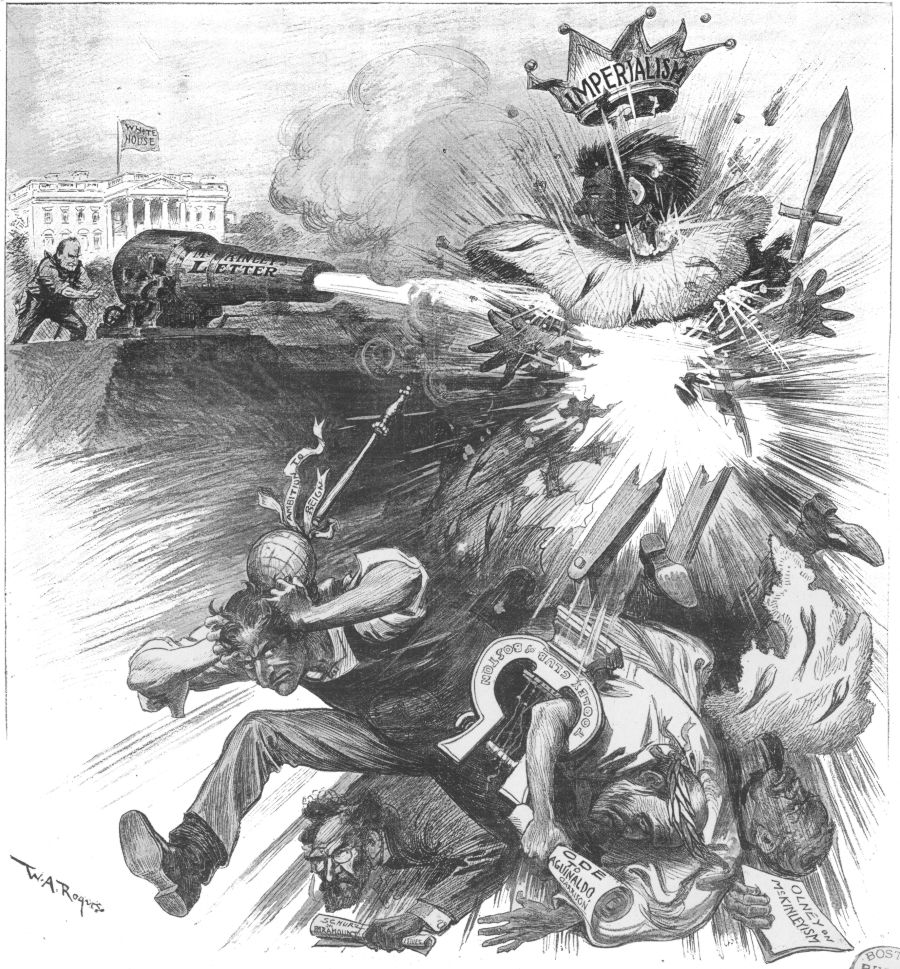
Attacking the Fake — image from Wikimedia Commons
McKinley Destroys Imperialism Straw Man · William Allen Rogers; scanned by Bob Burkhardt · Public domain

In deductive logic, an argument is valid if it is impossible for the premises to be true while the conclusion is false. Validity depends entirely on the abstract skeleton of the argument, rather than the real-world accuracy of its claims. If the logical form forces the conclusion, the structure is valid even with absurd statements. Soundness requires more.

A sound argument combines a valid structure with premises that are factually true in reality, providing an absolute guarantee for the truth of its conclusion.

Source excerpt
An argument is valid if it is impossible for the premises to be true while the conclusion is false.

From the Knowverse course text.

Deduction, induction, and analogy

Deductive reasoning moves from a general rule to a guaranteed, specific fact with logical necessity. Inductive reasoning works in the opposite direction by drawing a generalized conclusion from specific, limited data points. Because induction relies on observed patterns rather than rigid formal structure, it deals in probability rather than absolute certainty.

Reasoning by analogy is a type of inductive reasoning where similarities between a familiar source and an unfamiliar target suggest they share additional unobserved traits, though irrelevant comparisons create a false analogy.

Source excerpt
This process is called induction, which is the act of drawing a generalized conclusion from specific, limited data points.

From the Knowverse course text.

A fallacy is a flaw in reasoning that makes an argument weak or logically invalid, regardless of how persuasive it sounds. In an Ad Hominem fallacy, someone ignores the actual argument and instead attacks the character or personal traits of the speaker.

A Straw Man fallacy occurs when someone misrepresents an opponent's position by making it sound extreme or ridiculous to make it easier to attack. Structural errors include the False Dilemma, which presents only two options when more exist, and Begging the Question.

Source excerpt
A fallacy is a flaw in reasoning that makes an argument weak or logically invalid, regardless of how persuasive the speaker might sound.

From the Knowverse course text.

Sources

Sources: The Philosophical Toolkit. Each question or step includes an excerpt from the course.