Question 1
What is a period?
Periods run horizontally across the table.
Source excerpt
A period is simply a horizontal row that runs across the table, much like a single week on a wall calendar.
From the Knowverse course text.
 knowverse
Groups and periods organize the periodic table by atomic number with periods running horizontally and groups vertically. The quiz covers atomic number, metalloids like silicon, periodic table families including alkali metals and halogens, ionization energy, and electronegativity trends. Try the ten questions to check your understanding.
Your score is next.
Periods run horizontally across the table.
A period is simply a horizontal row that runs across the table, much like a single week on a wall calendar.
From the Knowverse course text.
Groups run vertically and often contain chemically related elements.
While rows are periods, the vertical columns that run from top to bottom are called groups.
From the Knowverse course text.
Atomic number counts protons.
No. An element's position is determined by its atomic number (the number of protons). Since an element's identity is defined by that number, its 'address' on the table is permanent and unchanging.
From the Knowverse course text.
Malleability is a typical metallic property.
Beyond being shiny, metals are famous for their malleability, or the ability to be hammered into thin sheets.
From the Knowverse course text.
Silicon has intermediate electrical properties useful in electronics.
The most famous metalloid is Silicon, which is a semiconductor.
From the Knowverse course text.
Alkali metals occupy Group 1, with hydrogen a nonmetal exception above them.
The Alkali metals are found in the very first column on the left side, which we call Group 1.
From the Knowverse course text.
Halogens are Group 17 nonmetals.
These are the Halogens, located in Group 17, just one column away from the very end of the table.
From the Knowverse course text.
Noble gases occupy Group 18.
The Noble gases sit in the very last column on the right, known as Group 18.
From the Knowverse course text.
Ionization energy concerns removing an electron.
Ionization energy is the specific amount of energy required to remove one electron from a neutral atom.
From the Knowverse course text.
Electronegativity compares how strongly bonded atoms attract shared electrons.
This specific ability of an atom to attract shared electrons toward itself is called electronegativity.
From the Knowverse course text.
See the answer and explanation for each question below.
Find more quizzes and full courses in the free iOS app.
Read more about the topic
The periodic table orders elements by atomic number, the number of protons in the nucleus. Horizontal rows are periods, while vertical columns are groups. Elements within a group often show related chemical behaviour. This organization helps chemists compare elements and look for patterns rather than treat each one as unrelated.
Metals typically conduct heat and electricity and can be shaped without shattering. Solid nonmetals often behave differently, while metalloids have intermediate properties. Silicon is a familiar semiconductor. These categories describe patterns rather than an exception-free checklist: hydrogen, for example, is a nonmetal even though it appears above the alkali metals.
While rows are periods, the vertical columns that run from top to bottom are called groups.
From the Knowverse course text.
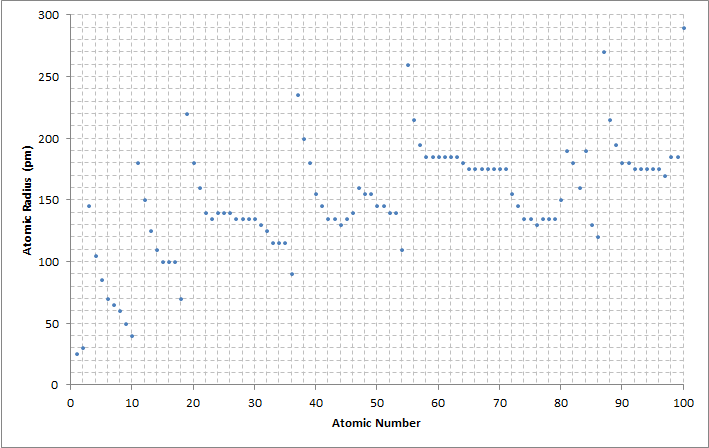
Valence electrons occupy the outer part of an atom and help determine its chemical behaviour. Alkali metals belong to Group 1, halogens to Group 17 and noble gases to Group 18. Noble gases are relatively unreactive under ordinary conditions, while alkali metals and halogens readily form many compounds.
Ionization energy measures the energy needed to remove an electron from an atom. Electronegativity describes attraction for shared electrons in a bond. They measure different situations. Inner electrons also shield outer electrons from some nuclear attraction, helping explain why atomic size and electron-removal energy change across the table.
Ionization energy is the specific amount of energy required to remove one electron from a neutral atom.
From the Knowverse course text.
Sources: The Logic of the Periodic Table. Each question or step includes an excerpt from the course.
